
Project Clearview

Project CLEARVIEW is an advanced aerospace technology initiative focused on addressing one of the most persistent challenges in hypersonic flight and missile defense: the degradation of sensor and communication performance caused by plasma-rich flight environments. The project explores the use of localized electromagnetic field management to improve the resilience of onboard sensing and guidance systems operating under extreme atmospheric conditions. By targeting the interaction between electromagnetic signals and surrounding plasma, the concept aims to enhance situational awareness, tracking accuracy, and mission effectiveness during critical phases of high-speed flight.

Designed as a scalable subsystem rather than a standalone platform, CLEARVIEW is intended for integration into next-generation aerospace and defense architectures where reliable sensing and communications are essential. The program combines expertise in plasma physics, electromagnetic systems, advanced modeling, and systems engineering to develop practical solutions for operating in environments that traditionally limit vehicle performance. Beyond defense applications, the underlying technology may offer broader relevance to high-speed aerospace systems, advanced communications, and other industries that require reliable operation in plasma-influenced environments.

APEX-GEO AI-driven Geospatial Intelligence System

Driven by curiosity and built on purpose, this is where bold thinking meets thoughtful execution. Let’s create something meaningful together.
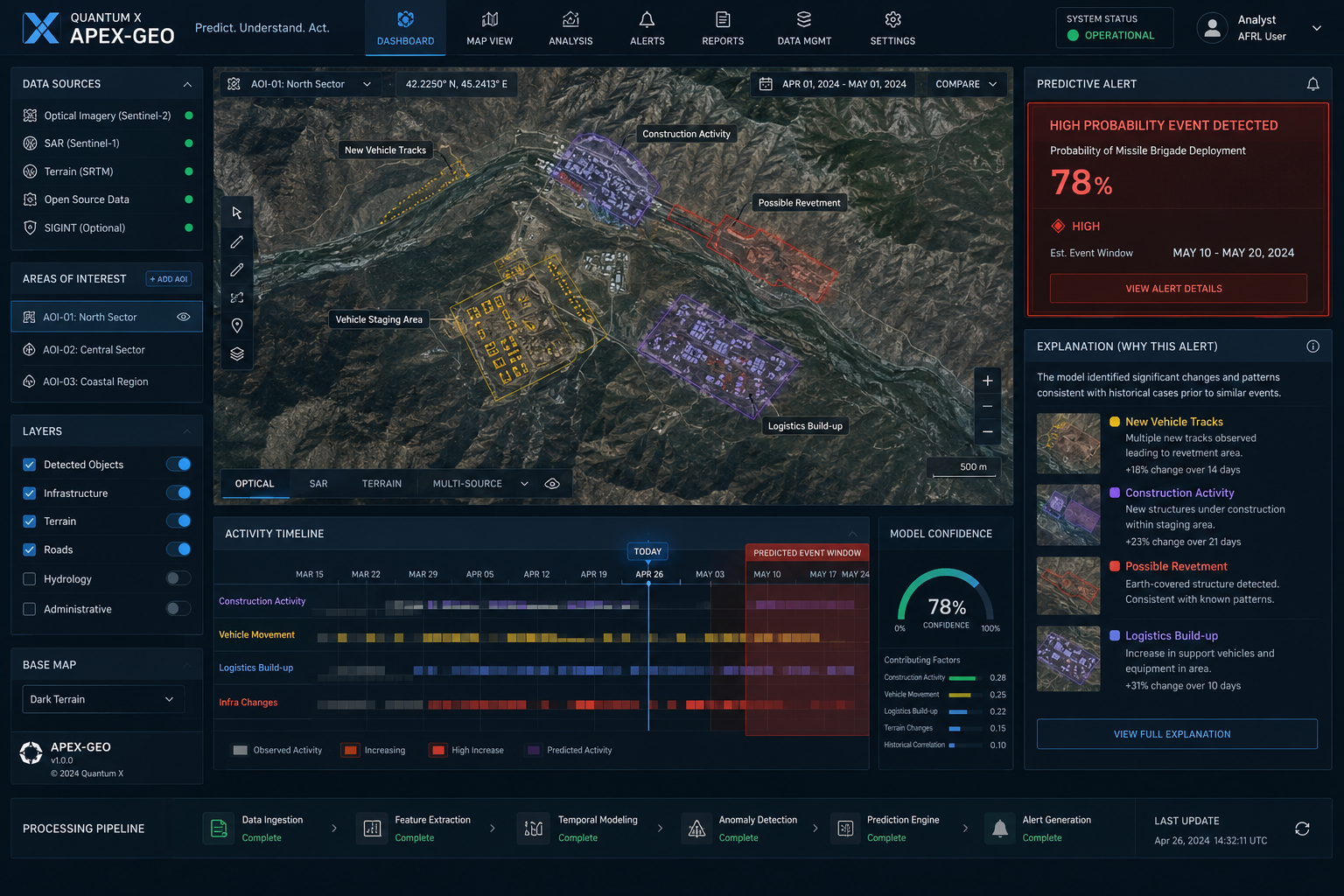
Quantum X APEX-GEO is an AI-driven geospatial intelligence platform designed and being tested to transform GEOINT from a reactive analysis process into a predictive decision-support system. By fusing multi-source data—including satellite imagery, radar, terrain models, and open-source intelligence—the system builds a unified spatiotemporal understanding of activity patterns across time and geography. Advanced machine learning models identify subtle changes, correlate long-term trends, and generate probabilistic forecasts of emerging activity, enabling earlier awareness of developing situations.

At its core, APEX-GEO integrates multi-modal deep learning architectures with temporal sequence modeling and anomaly detection to detect precursor signals that precede significant events. The platform includes an explainable intelligence layer that highlights the geospatial features driving each prediction, supporting analyst trust and rapid validation. Designed for scalability across defense and intelligence environments, the system reduces analytical burden, improves consistency in interpretation, and enhances situational awareness across large operational areas.

Operationally, APEX-GEO functions as a modular intelligence engine that can be deployed across different mission contexts, enabling tailored outputs for air, land, and maritime domains. Its architecture is designed to integrate with existing GEOINT infrastructures while improving speed, automation, and cross-domain data fusion. The result is a software-centric capability that augments human analysts, increases coverage of monitored regions, and significantly accelerates the transition from raw geospatial data to actionable intelligence.